
The Bar Profit Guys
$0.00 (0)  MY CART
MY CART MY CART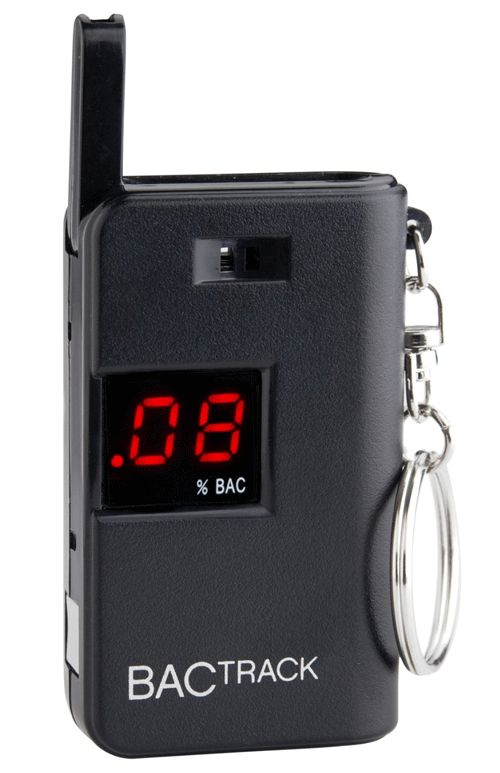 Click Here to check out the BACTrack Digital Breathalyzer.
Alcohol Testing Summary |
|
|
Several different methods are available for alcohol testing. Alcohol can be tested in the blood, breath, urine and saliva.
|
|
|
Blood Alcohol Concentration (BAC) is considered to be the standard for measuring the degree to which an individual is impaired by alcohol. For years, studies have shown that there is a direct correlation between the blood alcohol concentration and the degree to which reactions and judgments are impaired. The methodology used for blood alcohol testing is Gas Chromatography and is the most accurate forensic quality test in the industry today. However, drawing blood is an invasive and expensive procedure that most companies prefer to avoid.
|
| Breath Alcohol Testing | It is well proven that there is a direct correlation between a person's blood alcohol concentration and his breath alcohol contents. During respiration, gas is exchanged from the lungs to the blood (primarily oxygen) during inhalation, and visa versa (primarily C02) during exhalation. During this exchange, alcohol in the blood vaporizes and is carried out of the lungs in the exhaled breath. There are several types of breath alcohol testers available today. These range from disposable screening testers to the equipment that provides legally admissible results, including very expensive digital read-out breath alcohol monitors. These types of testers fall into three categories:
|
| The
evidential breath testing devices The portable hand held devices: By measuring the alcohol content in the breath, a reliable indication of the blood alcohol level is achieved. The disposable devices are noninvasive, less accurate and non scalable methods of screening for alcohol. Can be used to detect the presence of alcohol with a rough estimate to the degree of impairment. Being disposable, the cost per test for preliminary screening is considerably higher than the cost of testing using portable devices. Here's
how they work: |
|
Urine Alcohol Testing |
Although
urine alcohol testing will indicate the presence of alcohol in
a person's body, it will not indicate an individual's current
condition. Once consumed, alcohol enters the blood through the
stomach within 15 minutes, causing immediate impairment. It is
then metabolized by the body and, after 1½ to 2 hours,
will begin to show up in the urine. Therefore, urine alcohol does
not measure a true condition of the person. The results indicate
the person's condition several hours before. At
least one study has indicated that a false positive for urine alcohol
can occur. High levels of sugar and acetone in the body can cause
fermentation in the urine, creating a false positive for urine alcohol.
All things considered, the urine alcohol test is the least preferred
or perhaps acurate test available for alcohol testing. It is worthwhile
to read a supporting research paper published in
THE AMERICAN JOURNAL OF CLINICAL PATHOLOGY THE AMERICAN JOURNAL
OF CLINICAL PATHOLOGY: ERRORS
OF CONVERTING A URINE ALCOHOL VALUE INTO A BLOOD ALCOHOL LEVEL.SIDNEY
KAYE, PH.D., AND EDUARDO CARDONA, M.S. |
| Saliva Alcohol Testing |
The
second type of disposable tester available today tests the saliva
for alcohol presence. Although a correlation between blood alcohol
concentration and saliva alcohol concentration is believed to
exist, the technology and chemical reaction employed has not been
proven to be accurate or reliable. Additionally, most saliva testers do not have test results from independent laboratories. |